World International Press Club Stands with Journalists in Sri Lanka,
Afghan news24 Afgnews24
World International Press Club Stands with Journalists in Sri Lanka,
Calls on Government to Protect Media Freedom
By Our Staff Reporter
The World International Press Club (WIPC) has expressed its solidarity with the demands of journalists in Sri Lanka for the protection of their rights, freedom of expression, and media freedom. The organization has called on the Sri Lankan government to take effective measures to ensure the professional safety of journalists, their right to publish news independently, and the protection of a democratic environment.
Concerns have emerged among journalists and civil rights organizations regarding the proposed anti-terrorism law in Sri Lanka. The protection of media freedom, freedom of expression, and the confidentiality of journalists’ sources have become particularly important issues in this discussion.
The World International Press Club believes that ensuring journalists can perform their duties independently, publish truthful news, and report information concerning the public interest is extremely important. Appropriate legal safeguards must be in place to ensure that legitimate journalistic activities, freedom of expression, and investigative journalism in the public interest are not obstructed in the name of national security.
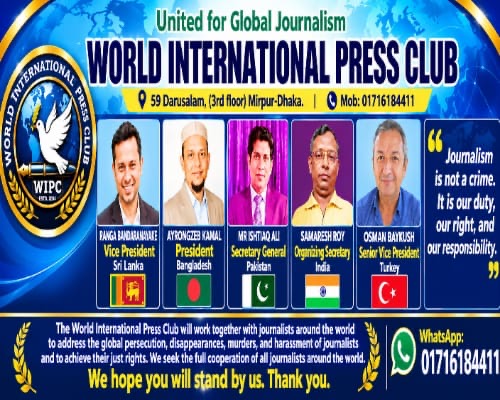
The President of the World International Press Club, Aurangzeb Kamal, said that protecting journalists’ rights and media freedom is a collective responsibility of the international journalistic community. Whenever concerns arise regarding journalists’ right to work independently in any country around the world, the international journalistic community should stand united in support of those rights.
He said, “We express our solidarity with the demands for protecting the rights, safety, professional dignity, and media freedom of journalists in Sri Lanka. It is essential to ensure that journalists can report the truth without fear, intimidation, or the threat of retaliation. We call on the Sri Lankan government to take the concerns of journalists’ organizations and relevant stakeholders seriously and to take the necessary measures to safeguard media freedom and independent journalism.”
He further stated that international journalistic solidarity is not about taking a position against any country. Rather, it is an important initiative for constructive cooperation in protecting the fundamental rights of journalists, the rule of law, and democratic values.
The Secretary-General of the Central Executive Committee of the organization, Mian Ishtiaq Ali of Pakistan, said that ensuring journalists’ freedom and safety is an important responsibility of a responsible state. Effective measures are necessary to protect journalists in the performance of their professional duties, safeguard the confidentiality of their sources, and uphold their right to publish news in the public interest.
He said, “The World International Press Club expresses its solidarity with the journalistic community of Sri Lanka. We hope that the Sri Lankan government will give serious consideration to the statements and concerns of journalists’ organizations and ensure an environment in which journalists can perform their professional duties independently, fearlessly, and responsibly.”
The World International Press Club has issued several important appeals to the Sri Lankan government.
First, the right of journalists to gather and publish news independently must be guaranteed.
Second, provisions of the proposed anti-terrorism law that could pose risks to freedom of expression, investigative journalism, or the confidentiality of journalists’ sources must be reconsidered through an independent legal review.
Third, effective safeguards must be ensured to prevent harassment, intimidation, and unreasonable restrictions against journalists arising from their professional activities.
Fourth, meaningful consultations must be held with journalists’ organizations, media professionals, legal experts, and civil rights organizations to establish measures that protect media freedom.
Fifth, any legislation concerning national security must uphold human rights, fair trial standards, the rule of law, and constitutional rights, both in its formulation and implementation.
The World International Press Club has called on the government to address the problems affecting independent journalism in Sri Lanka promptly and to take appropriate legal measures to protect press freedom.
Those expressing these demands on behalf of the World International Press Club include:
Aurangzeb Kamal — President, Bangladesh
Osman Baykus — Senior Vice President, Turkey
Ranga Bandaranayake — Vice President, Sri Lanka
Mian Ishtiaq Ali — Secretary-General of the Central Executive Committee, Pakistan
Syed Yasin Matin — Joint Secretary, Afghanistan
Samaresh Roy — Central Organizing Secretary, India
Alhaj Sohag — Office Secretary, Saudi Arabia
Shampa Das — Secretary for Women and Children’s Affairs, India
Md. Anis Pradhan — Executive Committee Member
Dr. Syed Khalid Qayes — Executive Committee Member, India
Mir Mohammad Ali — Permanent Member, India
Lakshman Muthuthanthirige — Executive Member, Sri Lanka
K. K. Dhammika — Executive Member, Sri Lanka
Shiromi Ratnayake — Executive Member, Sri Lanka
Lasantha Ruhunage — Involved in the organization’s activities, Sri Lanka
Mithun Jayawardhana — Involved in the organization’s activities, Sri Lanka
Sushil Aryal — Representative of Nepal, Nepal
Zeynep Tilkici — Member associated with the organization, Turkey
Fong Tze Hong — Involved in international activities, Malaysia
Kim Bolan — Involved in international activities, Canada
Paul Veyre — Involved in international activities, Canada
Marin Gugu, among others.
The World International Press Club has stated that mutual cooperation and solidarity at the international level must be further strengthened to protect journalists’ rights and freedoms. Press freedom is not merely a matter of professional interest for journalists; it is also closely connected to the public’s right to information, accountability, and the functioning of a democratic society.
The organization expressed hope that the Sri Lankan government would take the concerns of the journalistic community seriously and implement effective measures to protect journalists’ safety, freedom, and professional dignity.
The message of the World International Press Club: Journalists around the world must continue their united efforts to protect journalists’ rights, safeguard independent journalism, and strengthen international solidarity among members of the journalistic community.